America's history through the lens of 20th century broadcast media
Copyright 2020 Greenstone Media Consulting, LLC
Mel Blanc
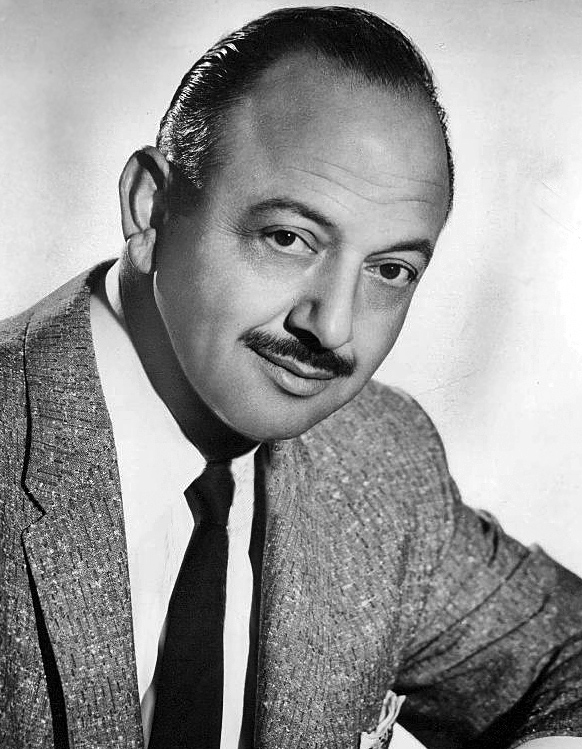
Mel Blanc was born in San Francisco, California. The family moved
to Portland, Oregon, where he attended Lincoln High School.
Growing up, he had a fondness for voices and dialect, which he
began voicing at the age of 10. Reportedly, he changed the spelling
of his name when he was 16, from "Blank" to "Blanc", because a
teacher told him that he would amount to nothing and be like his
name, a "blank", although he used both spellings somewhat
interchangeably for several years after his high school graduation.
Following his high school graduation, he split his time between
leading an orchestra and playing in several Portland bands including
one led by Herman Kenin. It was while performing in Kenin’s band in Portland’s Multnomah
Hotel “Breakfast Club” program that KGW Radio Hoot Owl Harry Grannatt saw Blanc and
recruited him to the Hoot Owls program. There, the young Blanc contributed fables in dialect
and other comic voices on the Hoot Owls.
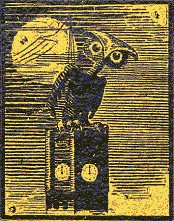
When Blanc was first asked to perform on the Hoot Owls (Hoot Owls logo pictured), readily
agreed to sing the popular standard “Juanita” (to which he knew the lyrics). But on arriving
at the KGW studio, he discovered that special lyrics had been
prepared. Blanc began his professional broadcasting career singing the
following into the KGW microphone:
Wanita
(to the tune of “Juanita”)
I’d be a wreck when I got the check
I prayed that she’d get indigestion
But such luck, it was out of the question.
They say nanny goats can eat soda cans and such,
My girl eats things nanny goats won’t touch.
I call her my sweet Wa nita:
“Wanna eat, wanna eat,” Wanita.
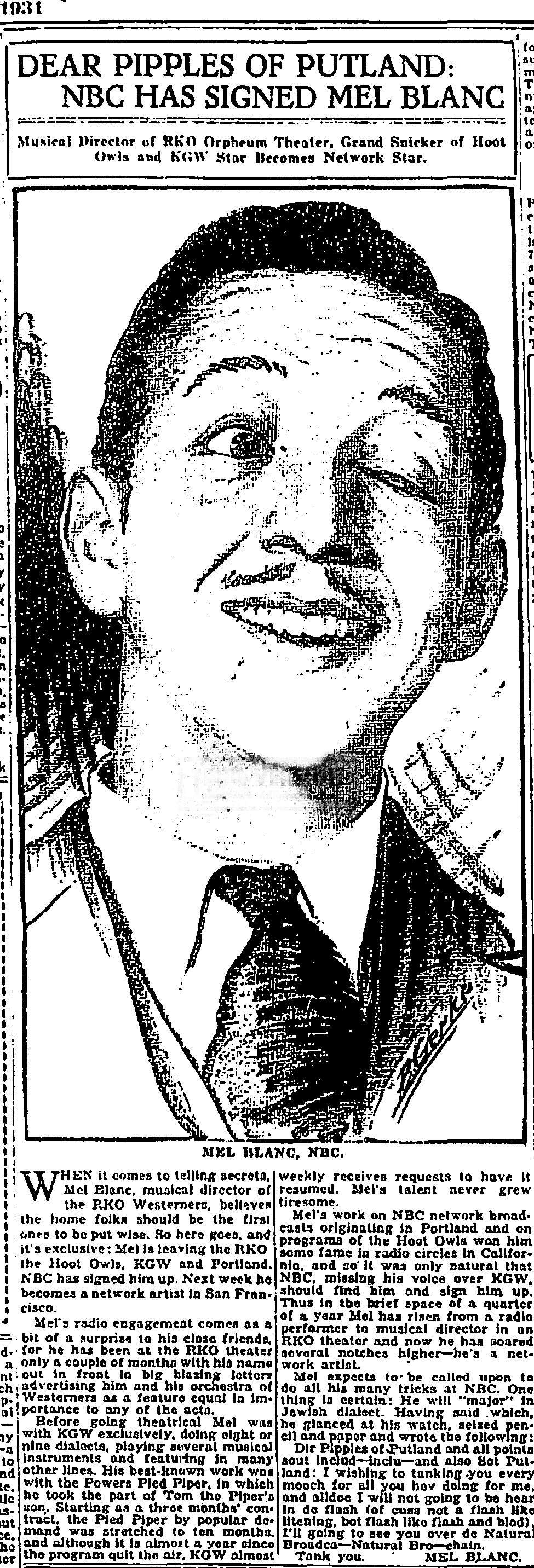
KGW also owned station Portland station KEX for a time and Blanc’s
talents soon were being used on both stations. [1931 newspaper
article about his first departure for LA] In 1932 he moved to Los
Angeles where he met Estelle Rosenbaum (1909–2003), whom he
married a year later, before returning to Portland and KEX in 1933.
There he agreed to produce and co-host his “Cobweb and Nuts” show
with his wife Estelle. The six-night-a-week program which he wrote and performed for two
years was exhausting and he decided to return to Los Angeles with his wife's encouragement.
There he was quickly engaged by Warner Bros.–owned KFWB in Hollywood in 1935. The
following year he switched to CBS Radio and The Joe Penner Show.
Blanc soon became a regular on NBC Red network’s “Jack Benny Program” in various roles,
including voicing Benny's Maxwell automobile (in desperate need of a tune-up), violin teacher
Professor LeBlanc, Polly the Parrot, Benny's pet polar bear Carmichael and the train
announcer. The first role came from a mishap when the recording of the automobile's sounds
failed to play on cue, prompting Blanc to take the microphone and improvise the sounds
himself. The audience reacted so positively that Benny decided to dispense with the
recording altogether and have Blanc continue in that role. One of Blanc's characters from
Benny's radio (and later TV) programs was "Sy, the Little Mexican", who spoke one word at a
time. He continued to work with Benny on radio until the series ended in 1955 and followed
the program into television from Benny's 1950 debut episode through guest spots on NBC
specials in the 1970s.
The cast of The Jack Benny Program, from left to right: Eddie "Rochester" Anderson, Dennis
Day, Phil Harris, Mary Livingstone, Jack Benny, Don Wilson, and Mel Blanc
Radio Daily magazine wrote in 1942 that Blanc "specialize[d] in over fifty-seven voices,
dialects, and intricate sound effects", and by 1946, he was appearing on over fifteen
programs in various supporting roles. His success on the “Jack Benny Program” led to his own
radio show on the CBS Radio Network, the “Mel Blanc Show”, which ran from September 3,
1946, to June 24, 1947. Blanc played himself as the hapless owner of a fix-it shop, as well as
his young cousin Zookie. Blanc also appeared on such other national radio programs as the
“Abbott and Costello Show”, “Burns and Allen”.
In December 1936, Mel Blanc joined Leon Schlesinger Productions, which was producing
theatrical cartoon shorts for Warner Bros. After sound man Treg Brown was put in charge of
cartoon voices, and Carl Stalling became music director, Brown introduced Blanc to animation
directors Tex Avery, Bob Clampett, Friz Freleng, and Frank Tashlin, who loved his voices.
The first cartoon Blanc worked on was Picador Porky (1937) as the voice of a drunken bull.
He soon after received his first starring role when he replaced Joe Dougherty as Porky Pig's
voice in Porky's Duck Hunt, which marked the debut of Daffy Duck, also voiced by Blanc.
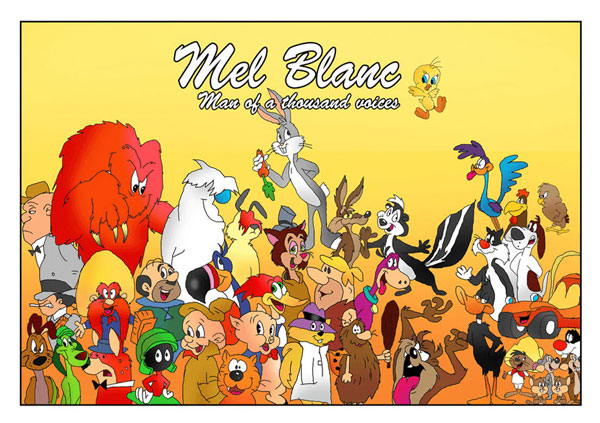
Blanc soon became a very prominent vocal artist for Warner Bros., voicing a wide variety of
the "Looney Tunes" characters. Bugs Bunny, as whom Blanc made his debut in A Wild Hare
(1940), was known for eating carrots frequently (especially while saying his catchphrase "Eh,
what's up, doc?"). To follow this sound with the animated voice, Blanc would bite into a
carrot and then quickly spit into a spittoon. One oft-repeated story is that Blanc was allergic
to carrots, which Blanc denied.
In Disney's Pinocchio, Blanc was hired to perform the voice of Gideon the Cat. However,
Gideon eventually was decided to be a mute character (similar to Dopey from Snow White
and the Seven Dwarfs), so all of Blanc's recorded dialogue was deleted except for a solitary
hiccup, which was heard three times in the finished film.
Blanc also originated the voice and laugh of Woody
Woodpecker for the theatrical cartoons produced by
Walter Lantz for Universal Pictures, but stopped
voicing Woody after the character's first three shorts
when he was signed to an exclusive contract with
Warner Bros. Despite this, his laugh was still used in
the Woody Woodpecker cartoons until 1951, when
Grace Stafford recorded a softer version, while his
"Guess who!?" signature line was used in the opening titles until the end of the series and
closure of Walter Lantz Productions in 1972.
During World War II, Blanc served as the voice of the hapless Private Snafu in various
war-themed animated shorts.
Throughout his career, Blanc, aware of his talents, protected the rights to his voice
characterizations contractually and legally. He, and later his estate, never hesitated to take
civil action when those rights were violated. Voice actors at the time rarely received screen
credits, but Blanc was an exception; by 1944, his contract with Warner Bros. stipulated a
credit reading "Voice characterization(s) by Mel Blanc." According to his autobiography, Blanc
asked for and received this screen credit from studio boss Leon Schlesinger after he was
denied a salary raise. Initially, Blanc's screen credit was limited only to cartoons in which he
voiced Bugs Bunny. This changed in March of 1945 when the contract was amended to also
include a screen credit for cartoons featuring Porky Pig and/or Daffy Duck. This however,
excluded any shorts with the two characters made before that amendment occurred, even if
they released after the fact (Book Revue and Baby Bottleneck are both examples of this). By
the end of 1946, Blanc began receiving a screen credit in any subsequent Warner Bros.
cartoon for which he provided voices.
In 1960, after the expiration of his exclusive contract with Warner Bros., Blanc continued
working for them, but also began providing voices for the TV cartoons produced by
Hanna-Barbera; his roles during this time included Barney Rubble of The Flintstones and
Cosmo Spacely of The Jetsons. His other voice roles for Hanna-Barbera included Dino the
Dinosaur, Secret Squirrel, Speed Buggy, and Captain Caveman, as well as voices for Wally
Gator and The Perils of Penelope Pitstop.
Blanc also worked with former "Looney Tunes" director Chuck Jones, who by this time was
directing shorts with his own company Sib Tower 12 (later MGM Animation/Visual Arts), doing
vocal effects for the Tom and Jerry series from 1963 to 1967. Blanc was the first voice of
Toucan Sam in Froot Loops commercials.
Blanc reprised some of his Warner Bros. characters when the studio contracted him to make
new theatrical cartoons in the mid- to late 1960s. For these, Blanc voiced Daffy Duck and
Speedy Gonzales, the characters who received the most frequent use in these shorts (later,
newly introduced characters such as Cool Cat and Merlin the Magic Mouse were voiced by
Larry Storch). Blanc also continued to voice the "Looney Tunes" for the bridging sequences of
The Bugs Bunny Show, as well as in numerous animated advertisements and several
compilation features, such as The Bugs Bunny/Road Runner Movie (1979). He also voiced
Granny in 4 More Adventures of Bugs Bunny (1974) and Bugs Bunny’s High-Fructose Christmas
Record (1974), in place of June Foray, and replaced the late Arthur Q. Bryan as Elmer Fudd's
voice during the post-golden age era.
On January 24, 1961, Blanc was involved in a near-fatal car accident when driving alone when
his sports car collided head-on with a car driven by 18-year-old college
student. Blanc was rushed to the UCLA Medical Center with a triple
skull fracture that left him in a coma for two weeks, along with
sustaining fractures to both legs and the pelvis. About two weeks after
the accident, one of Blanc's neurologists tried a different approach
than just trying to address Blanc himself: address his characters. Blanc
was asked, "How are you feeling today, Bugs Bunny?" After a slight
pause, Blanc answered, in a weak voice, "Eh... just fine, Doc. How
are you?" The doctor then asked Tweety if he was there, too. "I tawt I
taw a puddy tat," was the reply.
Years later, Blanc revealed that during his recovery, his son Noel "ghosted" several Warner
Bros. cartoons' voice tracks for him. Warner Bros. had also asked Stan Freberg to provide the
voice for Bugs Bunny, but Freberg declined, out of respect for Blanc. At the time of the
accident, Blanc was also serving as the voice of Barney Rubble in The Flintstones. His absence
from the show was relatively brief; Daws Butler provided the voice of Barney for a few
episodes, after which the show's producers set up recording equipment in Blanc's hospital
room and later at his home to allow him to work from there. Some of the recordings were
made while he was in full-body cast as he lay flat on his back with the other Flintstones
co-stars gathered around him. He returned to The Jack Benny Program to film the program's
1961 Christmas show, moving around by crutches and a wheelchair.
Blanc, an inveterate smoker from a young age, was diagnosed with emphysema when he was
77 and gave up the habit. On May 19, 1989, Blanc was checked into Cedars-Sinai Medical
Center in Los Angeles by his family when they noticed he had a bad cough while shooting a
commercial. While he was originally expected to recover. Blanc's health then took a turn for
the worse and doctors found that he had advanced coronary artery disease. He died on July
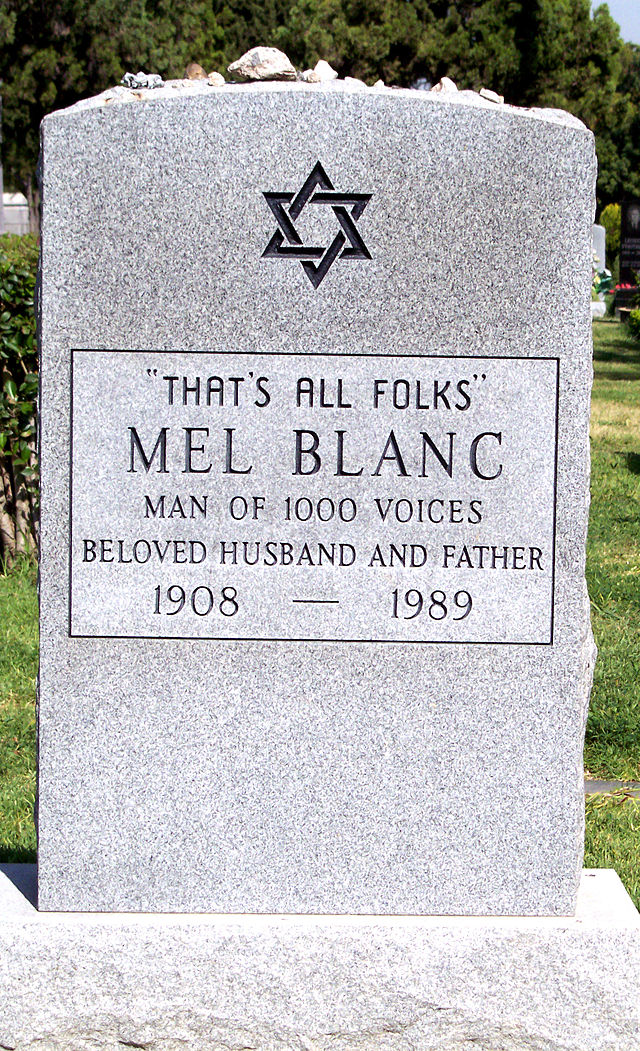
10 at Cedars-Sinai, at the age of 81. He is interred in Hollywood Forever in Hollywood.
Blanc's will stated his desire to have the inscription on his gravestone read, "THAT'S ALL
FOLKS", the catchphrase that was the hallmark of Blanc's character, Porky Pig.
He is regarded as the most prolific voice actor in the history of the industry and was the first
voice actor to receive on-screen credit.
