America's history through the lens of 20th century broadcast media

Copyright 2020 Greenstone Media Consulting, LLC
Broadcast History
(Keep Growing Wiser Order of) Hoot Owls
KGW, Portland OR
1923 - 1933
NBC-Red
1928 - 1932 occasional
KAST, Astoria, OR
1930 - 1932
Occasionally carried on
KLX, San Francisco
1923 - 1933
NBC-Red
1928 - 1932 occasional
KAST, Astoria, OR
1930 - 1932
Occasionally carried on
KLX, San Francisco
Hoot Owl logo, 1924 - 1933
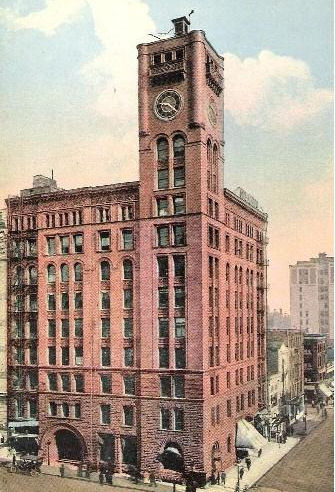
The Oregonian had earlier constructed an iconic
building on the corner of Sixth and Alder Streets,
the first steel-frame building wests of the
Mississippi, which featured a huge clock tower.
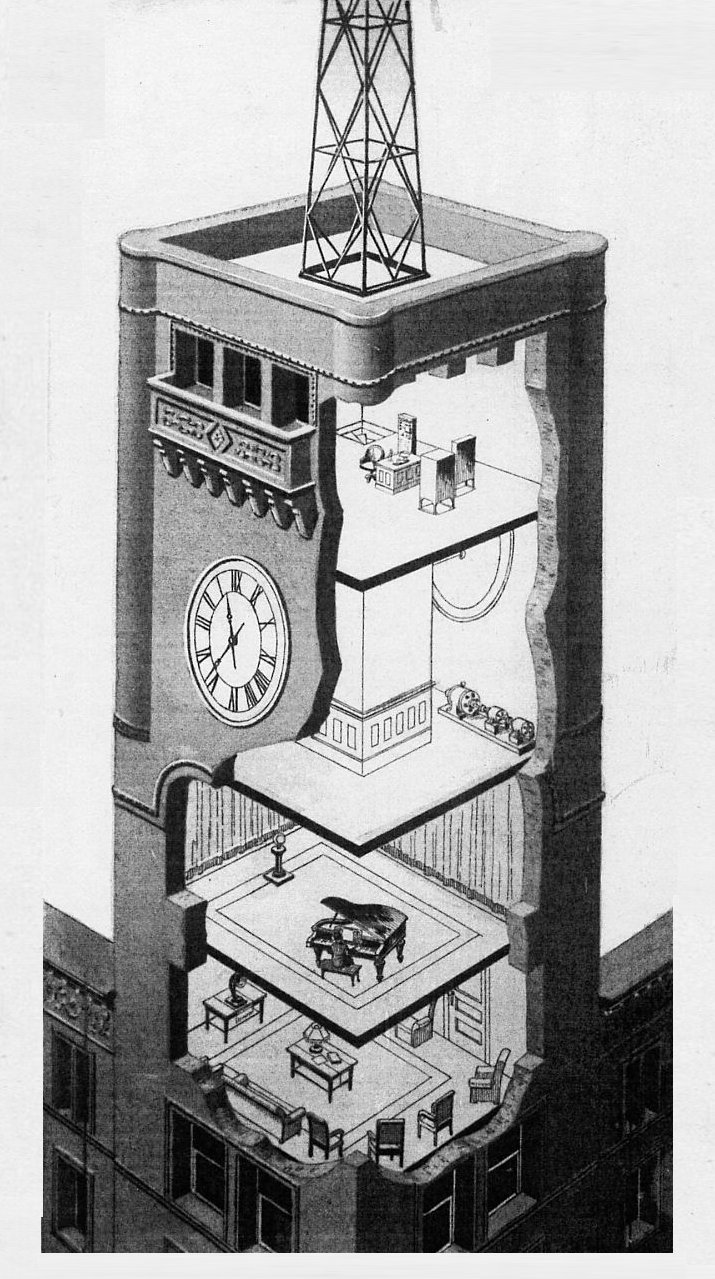
KGW's transmission equipment was located at the
top of the clock tower along with the station's
primitive "studio." At that time a radio transmitter
required two towers with the transmission wire(s)
stretched between them. One such tower was
located on the clock tower roof and the other on
the Northwestern Bank Building, a full block away, with the transmission
wires stretched between them high above Alder Street.
While the program’s style evolved over time, the
Hoot Owls always used a somewhat formal
program structure arising from the program’s
founding concept as a club. The program opened
with a roll call of Hoot Owl officers followed by a
“business meeting” during which typical “club
business” was transacted including reading of
correspondence, answering questions,
acknowledging gifts and consideration of
membership applications. The Hoot Owls’ “rites”
at each meeting included singing of the official
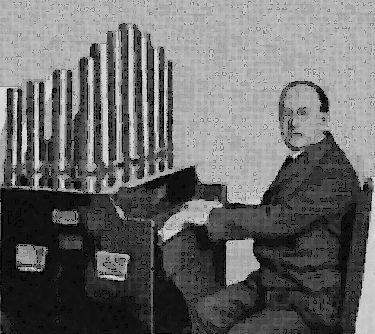
Hoot Owl song played with Owlorgan (a
circus calliope) accompaniment by Bishop
Sumner (shown at the Owlorgan) and the
riding of the group’s imaginary mascot, a
goat named Sweet William, by
newly-initiated members. Sunset Magazine,
which dubbed the Hoot Owls the “Laughter
Lodge of the Air,” described the Owlorgan as
“a music-making contraption that makes a racket like nothing ever heard
on land or sea.” Following these rites, the program
unfolded with both semi-scripted and
extemporaneous patter from members of the
Degree Team.
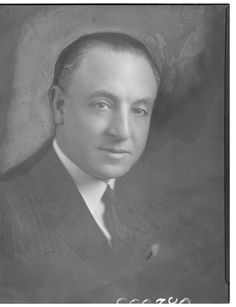
Charles F. Berg (pictured left) presided over the
gathering as Grand Screech. Club “officers” were
known collectively as the Degree Team and each
held a humorous title. Some of the initial Degree
Team members were Episcopal Bishop of Oregon, Walter F. Sumner, as
Grand Sermon. Life insurance agent Frank J. Sardam as Grand Scream,
announcer Dick Haller as Holder of the Grand Goat, pianist Alex Riley as
Grand Skipano, Guarantee Trust Company salesman Jim Albert as Grand
Shout, power company executive Bill Strandborg as Grand Talon ill
Hoffman as Grand Silence.
There are no recordings of the be the Hoot Owls program which was
broadcast before the technology existed to record live radio programs.
The program might best be described as what NBC-TV’s Saturday Night
would have sounded like if it had been done on the radio -sixty years
before NBC conceived of the television program. The program also had a
slight Marx Brothers (who were Owls and occasionally appeared on the
program) quality although one listener described the Hoot Owls as “funny,
more cerebral than slap-the-knee funny. Sunset Magazine described the
show as making “no attempt to uplift or elevate the brows of the
audience; there is not even stereotyped
announcing. It is a period of frivolity and
fun, a radio ‘get together’ of which the
fan feels he is a part” [emphasis in
original].
Stylized as a mythical lodge, the
program featured poetry, skits, music and spontaneous tomfoolery all in
the guise of a meeting of the Order – a “secret society of the air.”
Listeners submitted membership applications and those who were
accepted were inducted in a formal on-air ceremony. The Hoot Owls’
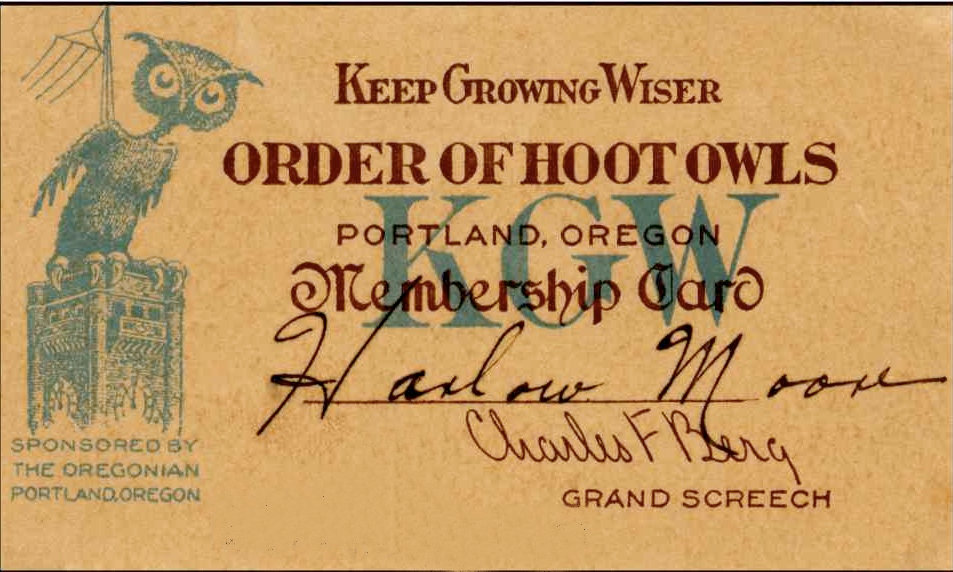
distinctive owl logo was originally created by Oregonian cartoonist C. L.
Smith and lucky inductees received highly-prized membership cards
featuring that symbol. Smith’s role as Hoot Owls’ cartoonist was later
assumed by another Oregonian cartoonist and future member of the
Degree Team, “Tige” Reynolds. Successful membership applications
supposedly required demonstration of some type of significant talent or
accomplishment – but the term was generously interpreted.