America's history through the lens of 20th century broadcast media

Copyright 2020 Greenstone Media Consulting, LLC
Seattle's Totem Broadcasters
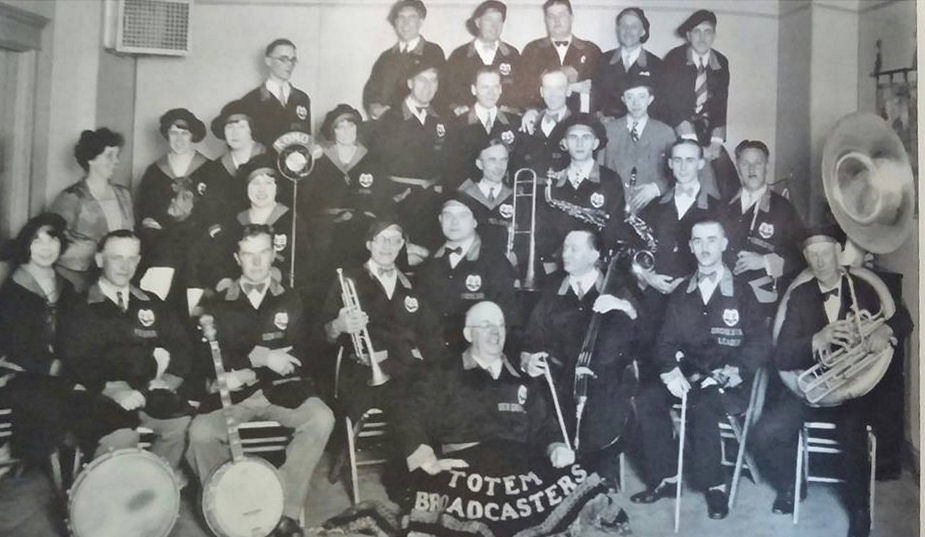
Totem Broadcasters Orchestra
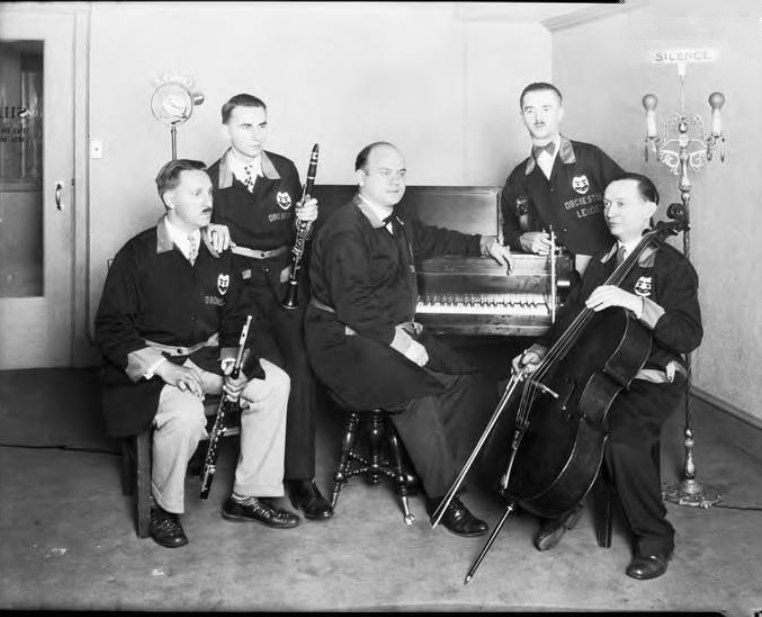
Totem Broadcasters band. Note the Totem Broadcasters logo on their jackets
Totem Broadcasters "Anihoots" logo (above) and explanation (below)

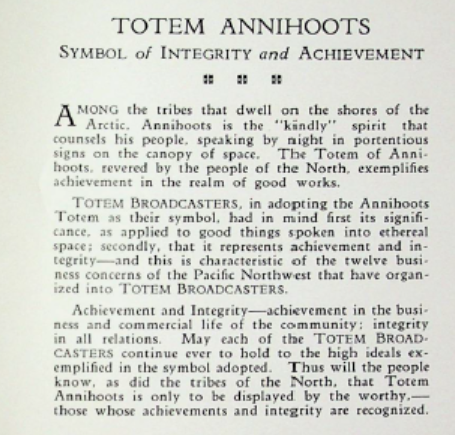
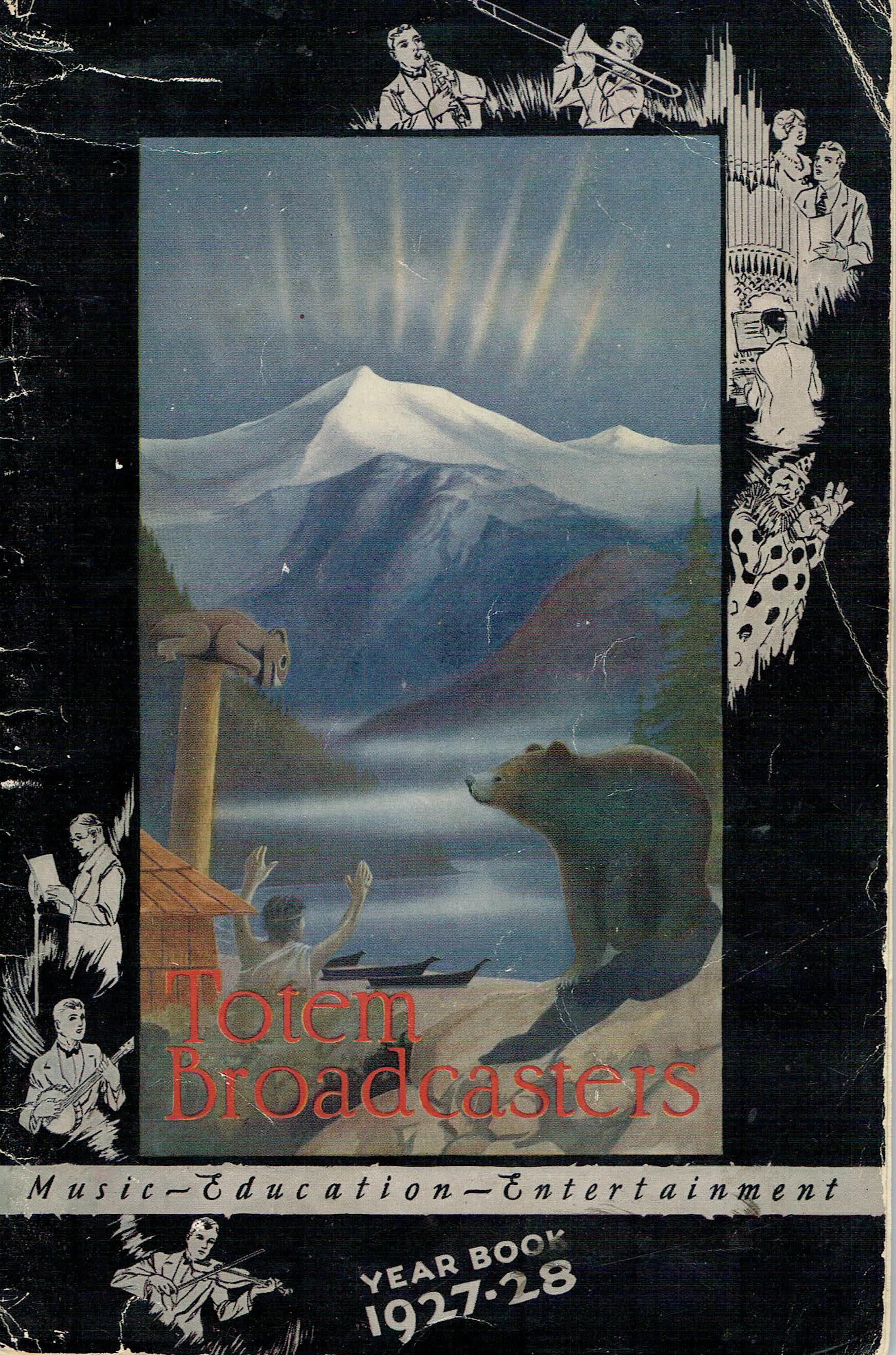
Totem Broadcasters 1927-1928 Yearbook
The radio “industry” as only about 5 years old when the
newly-established Federal Radio Commission (FRC) began creating
order in what had become an unruly, interference-ridden radio
environment. While stations’ frequencies, transmitting power and
hours of operation were being altered by the FRC some stations fared
pretty well in that fluid environment. Seattle’s KOMO was one of the
fortunate stations.
Founded in 1926 by two owners, O. W. Fisher and O. D. Fisher who
owned Fisher Flouring Mill and unrelated Birt F. Fisher, KOMO was
decently situated both in terms of technical facilities and funding.
Where radio stations had been operated sporadically in the 1922-1926
era, by 1927 many stations – including KOMO – were able to operate
regular day-long schedules. However, the commercial advertising
structure which eventually took over radio has still emerging and the question arose as to how
to support that many hours of broadcast operation.
O. D. Fisher (of the Flouring Mill) came up it a novel
answer by founding Totem Broadcasters. The
company, which claimed to be the nation’s first
radio production company, leased fourteen hours of
KOMO’s daily broadcast schedule. Totem’s
ownership was comprised of fourteen of the Seattle
area’s largest and most prominent businesses. At
Totem’s founding, its owners consisted of Eldridge Buick Company, the BeIlingham CoaI Mines,
American Mail Lines , Pacific Steamship Company, Frey and Company, General Insurance
Company, Imperial Candy Company, Metropolitan National Bank, Metropolitan BuiIding Company,
Puget Sound Power and Light, Schwabacher Brothers, Inc., Standard Furniture, Fisher's Blend
Station, Inc., and Fisher Flouring Mills. O. D. Fisher was Totem’s president.
By the end of Totem Broadcaster’s first
year the organization welcomed several
new participating businesses including the
Associated Oil Company, Pacific Fruit and
Produce Company, West Coast Theatres
and the Renfro-Wadenstein Company
department store.
Under the arrangement,
Totem would produce
fourteen hours a day of “’high class entertainment’ without
mechanically reproduced music” and each of the fourteen
Totem owners would sponsor one hour of each day’s KOMO
programming. As William Brubacher states in his Master’s
Thesis 'History of Radio in Seattle up to the Radio Act of
1927', “The establishment of Totem Broadcasters set a
precedent in providing a means to pay for radio
broadcasting.”
The founders apparently viewed their role in Totem as both a laudable civic, as well as wise
commercial, undertaking. Puget Sound Power and Light, for example, regularly included
“Member Totem Broadcasters” in its commercial display advertising.
As network radio evolved, KOMO’s affiliations with the National Broadcasting Company’s
NBC-related networks commanded increasing portions of the station’s airtime (under an
arrangement where the network would “purchase” that airtime in bulk at a reduced rate) thus
rreducing the need for Totem to provide KOMO with programming and advertising revenue.
Accordingly, Totem’s producer role diminished over time and the company, which remained in
operations for decades, evolved in different ways. For example, in 1933 Totem became the
operator KJR which had been leased to the Fishers Blend broadcasting group (the
owner/operator of KOMO). Totem also sought a role in television when, in the late 1940s and
continuing through the 1950s and allied with Fishers Blend, it sought various Federal
Communications Commission actions seeking to enter the Seattle area television market.
KOMO-TV, owned by the Fisher interests, signed on late in 1953.

.png)